
Communication objectives: the essential starting point of an effective content strategy
Within a communication strategy, one question is too often overlooked, even though it should be central: what is the objective behind each piece of content published?
Awareness, recruitment, engagement, loyalty, brand image… communication objectives are numerous, yet they are still too often implicit, or even missing, in content production. The result is regular publishing activity, but content that sometimes lacks direction and impact.
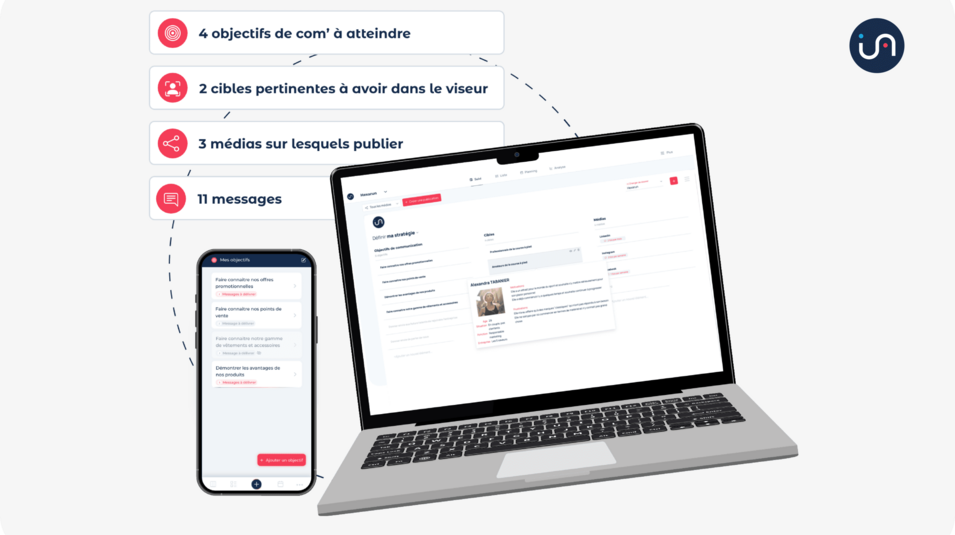
This is precisely the context in which ComInTime was created. At the origin of the tool was a recurring issue faced by many communication teams: the difficulty of clearly defining a communication objective for each published content piece. Many brands were publishing “just to publish”, without always linking their content to a clear strategic intention.
Today, ComInTime goes far beyond being a simple content creation or planning tool. The application places communication strategy at the heart of the editorial process by allowing each publication to be connected to an objective, a target audience, and a clear message.
Why communication objectives are at the core of an effective strategy
Giving meaning to every piece of content published
Content without an objective is content that loses part of its value. In a digital communication strategy, every publication must respond to a clear intention: inform, convince, recruit, retain, or strengthen brand awareness. Without this clarity, communication teams risk producing content that is disconnected from their real business challenges. The goal is therefore not simply to publish regularly, but to give a clear direction to every communication effort.
This logic is what transforms a digital presence into a truly structured and high-performing communication strategy.
Aligning communication with business goals
Communication objectives are not just marketing indicators: they are directly linked to the company’s overall business priorities. Recruiting new talent, generating leads, strengthening employer branding, or retaining audiences are all goals that must guide content creation. When properly defined, these objectives align communication teams with the company’s broader strategy. Each piece of content then becomes a lever serving a larger ambition, rather than an isolated action.This consistency is essential to ensure effective and measurable strategic communication over time.
Avoiding “intention-less” communication
One of the main issues observed in many organisations is volume-driven communication: publishing regularly without a clear intention behind each piece of content. This approach may create the impression of activity, but it does not always generate concrete results. Without defined objectives, it becomes difficult to measure the real impact of actions or adjust the editorial strategy.
This lack of structure is precisely what highlighted the need for a tool capable of placing objectives back at the centre of the communication process.
When communication objectives become difficult to structure in teams
A multiplication of content without a clear strategic framework
With the acceleration of digital channels, communication teams now produce a large volume of content. Social media, newsletters, blogs, advertising campaigns… formats are multiplying and publishing rhythms are intensifying. In this context, defining communication objectives often becomes secondary. Teams focus on execution, sometimes at the expense of strategic thinking. The result is content produced quickly, but not always linked to a precise intention.
A loss of visibility over real objectives
In many organisations, objectives do exist, but they are scattered or not clearly visible within daily tools. They are not always shared across teams, nor linked to published content. This lack of centralisation creates a major challenge: teams do not always know which objective is associated with which content. This limits the ability to steer overall performance of the content strategy.
Difficulty prioritising communication priorities
Not all communication objectives carry the same importance at any given time. Some periods focus on recruitment, others on brand awareness or loyalty. Without a tool to structure this prioritisation, teams can lose efficiency and consistency. Priorities evolve, but content does not always follow this strategic shift.
This issue of prioritisation and adaptability was also central to the design of ComInTime.
How ComInTime puts communication objectives back at the centre of strategy
Structuring objectives to provide a clear communication framework
ComInTime allows teams to clearly define their communication objectives from the strategic phase. Each objective can be created, structured, and integrated directly into the tool, serving as a foundation for all content production. This approach turns strategy into a concrete operational framework. Each publication can be linked to a specific objective, a defined target audience, and a consistent message. The objective is no longer abstract: it becomes an active element of content production.
Prioritising and evolving objectives over time
Communication needs constantly evolve. An objective that is a priority today may become secondary tomorrow, and then relevant again a few weeks later. ComInTime makes it possible to prioritise communication objectives, reorganise them, and even temporarily deactivate them when needed. For example, a recruitment objective can be paused and later reactivated depending on business needs.
This flexibility helps teams keep communication fully aligned with real-time priorities.
Linking each piece of content to a true strategic intention
One of ComInTime’s core principles is to connect every content piece to a clear strategic structure. Each publication can be associated with:
- a communication objective
- a precise target audience
- a message to deliver
This approach ensures overall consistency in corporate communication and makes it easier to measure the impact of each action. It transforms content production into a true strategic lever, rather than a series of isolated publications.
A high-performing communication strategy does not start with content creation, but with the definition of a clear intention. Communication objectives are the essential starting point for giving meaning, consistency, and impact to every message. This is exactly the purpose of ComInTime: helping teams bring strategy back to the heart of their communication by linking every content piece to an objective, a target audience, and a message.
By structuring, prioritising, and evolving these objectives over time, companies transform their communication into a true performance driver. Because ultimately, it is not the content that creates impact… but the strategic intention behind it.